Educational Disclaimer: This content is strictly for educational and research purposes and does not constitute financial, investment, or legal advice. Security practices described here reduce risk but cannot eliminate it. Always do your own research.
About the Author: Written by redpakpak, an independent writer digging into on-chain risk, stablecoin mechanics, and exchange security.
Every few months, a headline drops saying something like “$1.5 billion stolen in a crypto hack.” Read that as an outsider, and the conclusion feels obvious: blockchains must be fundamentally broken.
Here is the reality check. In almost every major theft on record, the core blockchain functioned exactly as designed. Nobody cracked Ethereum’s cryptography. Nobody rewrote Bitcoin’s history. What broke was nearly always sitting next to the chain: a distracted employee, a compromised laptop, a deceptive web interface, or flawed application logic.
This guide breaks down what a blockchain actually guarantees, where the money really leaks out, and why crypto security is ultimately a human problem rather than a math problem.
1. What a Blockchain Actually Protects
A blockchain is, at its core, an immutable shared ledger. Thousands of nodes maintain identical copies, accepting new entries only if they follow strict consensus rules. The foundational rule is simple: moving coins from an address requires a valid digital signature generated by that address’s private key.
That architecture gives the ledger two powerful properties:
- Signatures are practically unforgeable. Without the private key, computing a valid signature is computationally infeasible.
- History is extremely hard to rewrite on large networks because doing so requires overpowering the honest majority of mining power (Bitcoin) or staked capital (Ethereum).
Yet notice what the ledger never checks. It has no idea who you are. It doesn’t care if you intended to make a transfer. It asks only one question: is this cryptographic signature valid? If an adversary gets your key, or tricks you into approving a transaction, the network will process it with total impartiality.
The rare exception: small chains and 51% attacks
Claiming that blockchains can never be broken is misleading. Smaller networks backed by limited computational power remain vulnerable to brute-force realities. In 2020, Ethereum Classic suffered multiple 51% attacks where an aggressor rented mining power to reorganize blocks and double-spend about 807,000 ETC, worth roughly $5.6 million.
These network-layer attacks happen, but they target smaller chains. For dominant networks like Bitcoin and Ethereum, the cost of subverting consensus is astronomical. That is why today’s multi-billion-dollar losses almost never happen at the ledger level.
2. Where the Money Actually Leaks: Four Layers
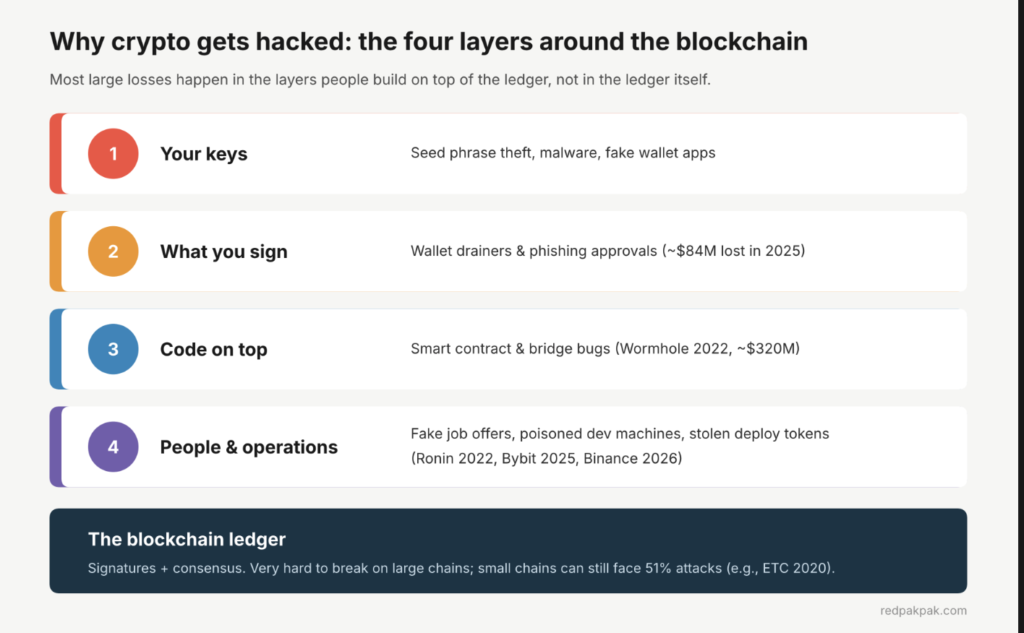
Think of a blockchain as a high-security vault surrounded by very thick walls. Attackers rarely waste time drilling through the concrete; they go after the human and operational perimeter guarding the vault. Most crypto losses map directly to four distinct layers:
| Layer | What gets attacked | Real example | Was the chain broken? |
|---|---|---|---|
| 1. Your keys | Seed phrases and private keys lost via malware, phishing, or poor storage | Individual wallet compromises | No |
| 2. What you sign | Deceptive UI prompts and malicious smart contract approvals (“drainers”) | ~$84M lost to phishing approvals in 2025 (Scam Sniffer) | No |
| 3. Code on top | Logic flaws in smart contracts and cross-chain token bridges | Wormhole bridge exploit, 2022 (~$320M) | No, application code failed |
| 4. People & operations | Employees, developers, and internal release pipelines at major platforms | Ronin (2022), Bybit (2025), Binance (2026) | No |
Layers 1 and 2 target individual users through direct manipulation. Layers 3 and 4 target platforms, generating the multi-million-dollar headlines.
3. Four Major Exploits, Four Human Failures
Wormhole (2022): an application logic bug
Wormhole acts as a bridge moving assets across independent blockchains. In February 2022, an attacker discovered a verification flaw in its Solana-side validation code. The bug allowed them to mint ~120,000 wrapped ether out of thin air (~$320 million) without providing collateral. The base chains remained pristine; the bridge contract’s logic failed.
Ronin (2022): a social engineering trap
Axie Infinity’s Ronin network required five of nine validator signatures to authorize bridge withdrawals. In March 2022, attackers captured five keys and drained nearly $620 million. Per reporting by The Block, the breach started when a senior engineer engaged with a fake recruitment campaign and opened a weaponized PDF. Four keys were harvested from internal servers; the fifth leaked via a neglected legacy permission.
Bybit (2025): a poisoned developer interface
Bybit secured large ether reserves using Safe{Wallet} multi-sig setups. In February 2025, attackers compromised a developer’s workstation and injected malicious code into the interface script. When Bybit’s signers reviewed what appeared to be a routine transaction, the modified UI tricked them into transferring control of the vault, resulting in a ~$1.5 billion loss. Safe’s smart contracts operated exactly as written; the interface trusted by humans was compromised.
Binance (2026): a hijacked approval pipeline
In October 2026, roughly $6.3 billion flowed out of Binance hot wallets in the largest crypto theft on record. Binance said it found no evidence that private keys leaked. Instead, attackers leveraged a fabricated job interview, infected a staff machine, and worked through an internal AI tool until they could reach the system that requests withdrawal signatures. We unpacked this architecture in our Binance hack analysis.
The recurring pattern
Look at these platform breaches side by side. In 2022, a fake job offer opened the door at Ronin. In 2026, a fake interview did the same at Binance. In between, Bybit signers were fed a malicious user interface. None of these attacks required cracking advanced math. They succeeded because they manipulated human trust and operational routines.
4. How to Explain a Private Key to Anyone
Traditional finance relies heavily on passwords, customer support desks, and fraud protection teams. Crypto changes those rules entirely. Several analogies help clarify what a private key actually means in practice:
- A key without a locksmith. A private key is not an account password you can reset via email. There is no “Forgot Password” button. Whoever holds the key opens the vault, and there is no bank manager to call when things go wrong.
- Physical cash, not a credit card. If your credit card is stolen, liability protections typically shield you from loss. Crypto transactions function more like physical cash handed to a stranger on the street. Once delivered, reversal is impossible.
- A signed blank check. Interacting with a malicious dApp approval is like signing a blank check and handing it to an unknown party. The blockchain cares only that your signature matches, not whether you understood the permissions granted.
- A high-stakes digital certificate. For Korean readers, a private key is a bit like a digital banking certificate (공동인증서) file. It is a handy local mental model, with one big difference: traditional banking errors can be frozen and investigated by institutional authorities, whereas a public blockchain offers no central recourse.
If there is one takeaway to keep in mind, it is this: the blockchain usually isn’t what gets hacked; the keys, code, and people around it are.
5. A Practical Checklist for Individuals
While you cannot control enterprise exchange infrastructure, you can systematically seal the attack vectors surrounding your own wallet:
- Never type your seed phrase into web browsers, chat applications, or support forms. No legitimate entity will ever request it.
- Scrutinize what you sign. If a decentralized app requests unlimited token allowances or ambiguous signature permissions, halt immediately.
- Verify data on hardware wallet screens rather than trusting browser extensions blindly. As the Bybit incident demonstrated, web interfaces can render entirely misleading information.
- Revoke historical allowances and unused token permissions regularly using reputable security tools.
- Bookmark trusted portals instead of clicking links embedded in search ads, emails, or social media threads.
- Compartmentalize capital. Keep an active browser wallet for everyday interactions, and isolate long-term holdings in a dormant cold storage address.
- Treat unsolicited professional outreach with extreme suspicion, especially if it involves executing code or reviewing files as part of a “recruitment assignment.”
For active DeFi users, Layer 3 vulnerabilities introduce separate structural risks. Explore our companion breakdowns on DeFi & RWA smart contract risks and why a swap’s quote and its actual fill can diverge.
Why Crypto Gets Hacked: FAQ
Can a blockchain network itself be hacked?
Established networks like Bitcoin and Ethereum maintain robust cryptographic and consensus security that has resisted core compromise. Smaller chains remain susceptible to 51% reorganization attacks, such as the 2020 Ethereum Classic incidents. However, the vast majority of headline hacks target keys, users, applications, or administrative systems rather than the base ledger.
Can a completed crypto transaction be reversed?
As a rule, no. Valid transactions settled on public blockchains are final on-chain. While select centralized stablecoin issuers retain administrative freeze keys for compliance, native assets like bitcoin and ether cannot be reversed or frozen on-chain by any company.
What is a wallet drainer?
A wallet drainer is a malicious phishing interface designed to trick users into signing transactions or approvals that grant unauthorized contracts permission to sweep funds. Your private key isn’t necessarily exported; rather, you hand over on-chain permission to move your tokens.
Does a hardware wallet guarantee absolute safety?
Hardware wallets protect private keys from host-computer malware, offering an essential layer of defense. However, they cannot protect against user error if you authorize a malicious transaction yourself. Always check the physical device screen before confirming any prompt.
Are centralized exchanges safer than self-custody?
Exchanges trade one risk profile for another. Leaving funds on a platform transfers security responsibility to corporate balance sheets and IT controls. Self-custody eliminates exchange counterparty risk but places 100% of the operational burden on your personal habits.
References
- The Block: Ethereum Classic suffers another 51% attack in five days (2020)
- The Register: How $320m in Ether was stolen from Wormhole (2022)
- The Block: How a fake job offer took down Axie Infinity’s Ronin (2022)
- BleepingComputer: Lazarus hacked Bybit via breached Safe{Wallet} developer machine (2025)
- BleepingComputer: Binance says fake job interview led to $6.3 billion crypto heist (2026)
- Scam Sniffer: 2025 crypto phishing losses report
Notice: This analysis is for education only. RedPakPak does not offer investment, financial, or legal advice, nor does it endorse any wallet, exchange, or protocol.