Educational Disclaimer: This content is for educational purposes only and does not constitute financial, investment, or legal advice. Always do your own research.
About the Author: Written by redpakpak, an independent writer digging into on-chain risk, stablecoin mechanics, and exchange security.
After the October 2026 Binance hack, something odd happened. Within hours, stablecoin issuers led by Tether and Circle froze about $3 billion of the stolen funds. But the same attackers also took 18,270 bitcoin, and nobody could freeze a single one of those coins on-chain.
Same hack, same attackers, same public ledgers anyone can watch. People often ask: Can Bitcoin and Ethereum be frozen the way stablecoins are? The short answer is no.
The longer answer is more interesting, because “can’t be frozen” is not quite the whole truth either. Let’s break down why Can Bitcoin and Ethereum Be Frozen remains a crucial question in crypto security.
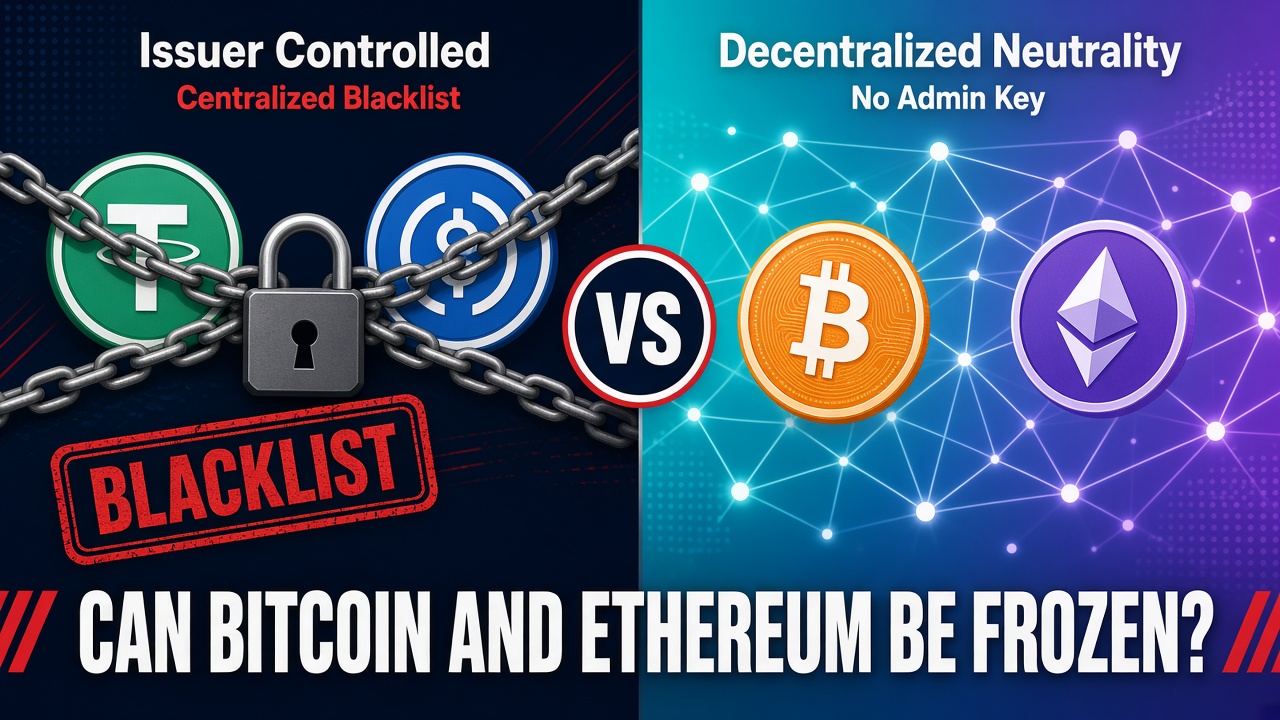
1. Why Stablecoins Can Be Frozen While Native Coins Move
Bitcoin is the native coin of its own blockchain. Ether is the native coin of Ethereum. USDT and USDC are different: they are tokens created by smart contracts that run on top of blockchains such as Ethereum, Tron, and Solana.
Whoever writes a token contract decides its rules. Tether and Circle wrote theirs with admin functions that let the issuer blacklist an address. Circle’s USDC contract has a blacklist function; Tether’s USDT contract has addBlackList, plus a function that can destroy the blacklisted balance. Once an address is on the list, the token contract simply refuses to move its balance.
Notice what happens here. Ethereum itself does nothing special. The freeze is just another valid transaction, signed by the issuer’s admin key and sent to the token contract. The blockchain processes it like any other. The power sits with the company, not the chain.
Not every stablecoin works this way. Some decentralized designs, such as the original DAI, were built without a blacklist function. But the two largest fiat-backed stablecoins, USDT and USDC, both have one, and they use it.
2. Why Bitcoin and Ether Have No Freeze Button
When analyzing Can Bitcoin and Ethereum Be Frozen at the protocol level, we find that both assets have no issuing company and no admin key. Their rules are enforced by thousands of independent nodes that each check every transaction for themselves.
Those nodes ask one main question: does this transaction carry a valid signature from the key that controls these coins? If yes, it is valid. The protocol has no field for “this address belongs to a hacker” and no switch to skip it.
This is the same neutrality that makes Bitcoin hard to censor. It is also why stolen BTC sitting in a thief’s own wallet cannot be pulled back by a court order or a company decision. Investigators can watch the coins move. They just can’t stop them on-chain.
3. Where the Line Blurs: Real Exceptions
Saying Can Bitcoin and Ethereum Be Frozen always results in a strict “never” goes too far. History has a few important exceptions, and each one works through a different door:
| Type | How it works | Example | Base Chain Modified? |
|---|---|---|---|
| Exchange freeze | An exchange locks balances in its own internal records | Exchanges freezing deposits linked to hacks | No, it happens off-chain |
| Hard fork or rollback | The community upgrades software to change ledger state | The DAO (Ethereum, 2016); value overflow bug (Bitcoin, 2010) | Yes |
| Validator freeze or halt | Validators on a smaller chain coordinate to block addresses or stop the chain | BNB Chain (2022); Cetus on Sui (2025) | Yes, on those chains |
| Block-level censorship | Some block builders leave out certain transactions | OFAC-compliant blocks after Tornado Cash sanctions (2022) | No, transactions are delayed, not frozen |
Exchange freezes: the most common one
If your BTC or ETH sits on an exchange, you don’t really hold coins on the blockchain. You hold a balance in the exchange’s database. The exchange can freeze that balance at any time, because of a court order, a compliance flag, or a hack. This is the freeze most people will actually run into.
The DAO hack (2016) and Ethereum Classic
In June 2016, an attacker used a bug in The DAO, an early investment contract, to drain about 3.6 million ETH. The Ethereum community then ran a hard fork in July 2016 that moved those funds into a contract where original investors could withdraw them. Part of the community refused the change and kept running the original chain, which became Ethereum Classic (ETC). It remains the clearest case of a major chain overriding its own ledger, and Ethereum has not done anything like it since.
Bitcoin’s 2010 value overflow bug
On August 15, 2010, a bug let someone create about 184 billion BTC in a single transaction, split across two addresses. Within hours, Satoshi Nakamoto released a fix. Miners switched to the patched software, and within about a day the corrected chain overtook the one containing the bad block, erasing the fake coins. This was a bug fix, not a hack recovery, and Bitcoin has never reversed a transaction like this since.
Smaller chains: BNB Chain and Sui
Chains with a small number of validators can act much faster. In October 2022, an attacker exploited a bridge on BNB Chain and minted about 2 million BNB. Validators halted the entire chain within hours, which kept most of the funds from leaving.
In May 2025, an exploit at the Cetus exchange on Sui took about $223 million. Sui validators coordinated to ignore transactions from the attacker’s addresses, freezing about $162 million. The Sui community later passed an on-chain governance vote to return those funds. That speed helped victims, but it also showed that on these chains a small group can decide to stop specific funds.
Censorship is not a freeze
After the U.S. Treasury sanctioned Tornado Cash in August 2022, many Ethereum block builders and relays began leaving out transactions linked to sanctioned addresses. By late 2022, more than half of new Ethereum blocks were OFAC-compliant. Those transactions were delayed, not blocked forever, because other validators still included them in later blocks. The share of compliant blocks fell in 2023, and the Treasury lifted the Tornado Cash sanctions in March 2025.
4. What This Means for You
- Where you hold it matters more than what you hold. On an exchange, BTC, ETH, and USDT can all be frozen, because the exchange controls the account.
- Stablecoins come with an issuer. Holding USDT or USDC means trusting the issuer’s reserves and accepting that it can freeze addresses. As we covered in our Binance hack analysis, that power helped recover billions this time, but the same switch can be used on any address.
- Self-custody means no safety net. BTC or ETH in your own wallet can’t be frozen by anyone, but if a thief takes it, no one can freeze it for you either. That is why protecting your keys matters so much, as explained in our guide on why crypto gets hacked.
Can Bitcoin and Ethereum Be Frozen? FAQ
Can the government freeze my Bitcoin?
Not on-chain. There is no admin key that can lock bitcoin in a self-custody wallet. Authorities can, however, order exchanges to freeze accounts, and they can seize coins if they get hold of the private keys.
Why can USDT and USDC be frozen but BTC can’t?
USDT and USDC are smart-contract tokens, and Tether and Circle built blacklist functions into those contracts. Bitcoin and ether are native coins with no issuer and no admin key.
Has a major blockchain ever reversed a hack?
Yes, once at large scale. Ethereum’s 2016 hard fork after The DAO hack returned the funds and led to the creation of Ethereum Classic. Bitcoin removed fake coins created by a bug in 2010, but has never reversed a hack.
Can validators censor Bitcoin or Ethereum transactions?
Individual miners or validators can choose to leave transactions out of their own blocks, as some Ethereum relays did after the 2022 Tornado Cash sanctions. But as long as other producers include them, the transactions still go through, just more slowly.
References
- CNBC: Circle and Tether freeze funds linked to Binance security issue (2026)
- Bitcoin Wiki: Value overflow incident (2010)
- ethereum.org: The DAO hack and Ethereum Classic
- The Block: BNB Chain resumes service after bridge exploit (2022)
- Cointelegraph: Sui validators freeze majority of stolen funds in Cetus hack (2025)
- The Block: Sui community passes vote to recover frozen Cetus funds (2025)
- The Block: 63% of Ethereum blocks are OFAC-compliant (2022)
Notice: This analysis is for education only. redpakpak does not offer investment, financial, or legal advice, nor does it endorse any wallet, exchange, or protocol.