Educational Disclaimer: This content is strictly for educational and research purposes and does not constitute financial, investment, legal, or gambling advice. Prediction markets involve the risk of losing your entire stake, and access is restricted or prohibited in some jurisdictions. Always check local rules and conduct independent due diligence.
About the Author: Written by redpakpak, an independent research initiative focused on on-chain risk analysis, DeFi mechanisms, and tokenized real-world asset structures.
Updated October 2026: This article was rewritten to give a balanced explanation of how outcome-based markets work, including how losses happen and the risks involved.
Polymarket often feels simpler than a stock or crypto chart. Each market asks a single yes-or-no question, and each share ends at either $1 or $0. That simplicity is real, but it is easy to misread. This guide explains what is genuinely different about outcome-based markets, and what is not.
For the mechanics of how prices are set, see our companion guide: How Polymarket Prices Work.
1. Price-based vs. outcome-based markets
A stock or a token has no end date. Its value depends on what the next buyer will pay, so traders watch price movement over time.
A prediction market share has a fixed ending. On the resolution date, a question such as “Will X happen by December 31?” is settled, and every share is paid out based on the answer.
| Stocks / crypto | Prediction market share | |
|---|---|---|
| End date | None | Fixed resolution date |
| Final value | Open-ended | $1.00 or $0.00 |
| What drives value | Earnings, demand, sentiment | Whether the event happens |
| Maximum loss | Amount invested (more with leverage) | Amount paid for the shares |
This structure is the main difference. It does not make prediction markets safer or easier to profit from. It only changes what you are trying to judge.
2. How settlement works
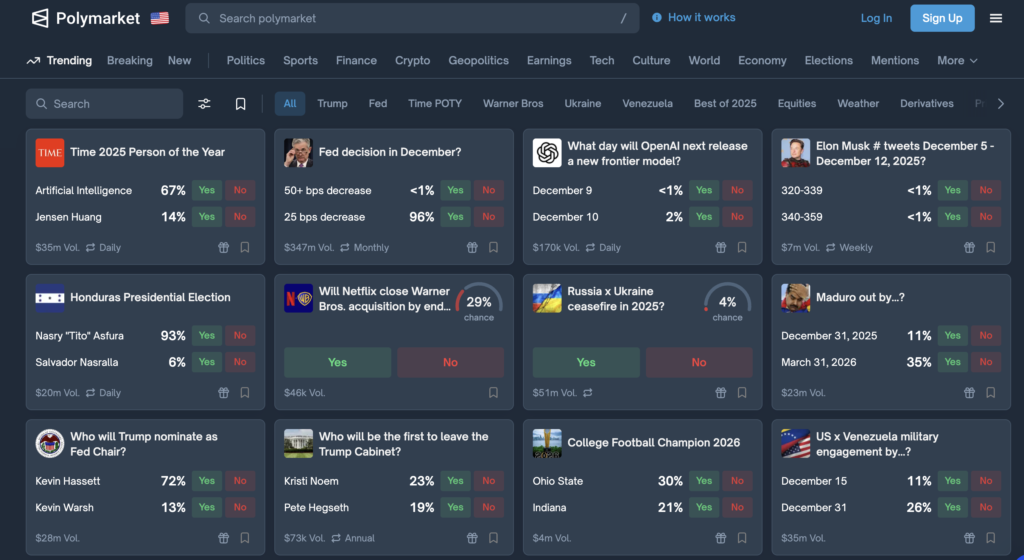
- If the event happens, each YES share pays $1.00 and each NO share pays $0.
- If the event does not happen, each NO share pays $1.00 and each YES share pays $0.
Because of this, a share’s price can be read as the market’s implied probability. A YES price of 70¢ means traders, as a group, are pricing the event at roughly 70%.
Your profit or loss per share is simple:
- Correct outcome: $1.00 − your purchase price
- Wrong outcome: − your purchase price (the full amount)
Buying at a high price means a small potential gain and a large potential loss. Buying YES at 90¢ risks 90¢ to make 10¢.
3. What a falling price really means
A common misconception is that a price drop “doesn’t matter” as long as you hold until the end. That is only true if your outcome turns out to be correct, and you cannot know that in advance.
If you bought YES at 80¢ and it now trades at 52¢:
- Selling now locks in a loss of 28¢ per share.
- Holding gives you $1.00 if YES wins, or $0 if it loses.
- The drop itself usually means other traders now see the outcome as less likely. It may reflect new information you do not have.
In other words, a falling price is an unrealized loss and a signal worth taking seriously, not noise to ignore.
4. Case study: “Will Bitcoin hit $100k in 2024?”
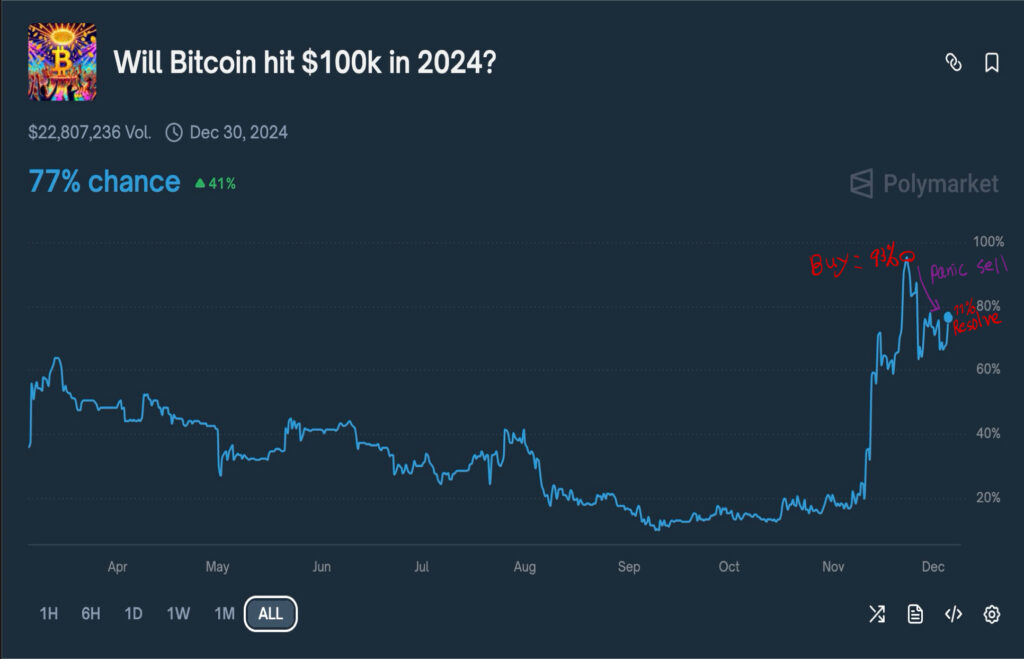
Consider a trader who bought YES at 93¢. The price later fell to 73¢ before Bitcoin crossed $100,000 in December 2024 and the market resolved YES. Three different paths show how the same entry can end very differently:
| Path | Result per share |
|---|---|
| Held to resolution, outcome YES | +7¢ ($1.00 − 93¢) |
| Sold during the dip at 73¢ | −20¢ |
| Held to resolution, if the outcome had been NO | −93¢ |
Looking back, holding worked. But at 73¢, the market was pricing roughly a 27% chance that it would not. The example shows the payoff structure, not a strategy: a 7¢ upside was paired with a 93¢ downside the whole time.
5. Case study: the 2025 Nobel Peace Prize market
Prediction market prices react to information, and sometimes that information is not public. The 2025 Nobel Peace Prize market is a widely reported example.
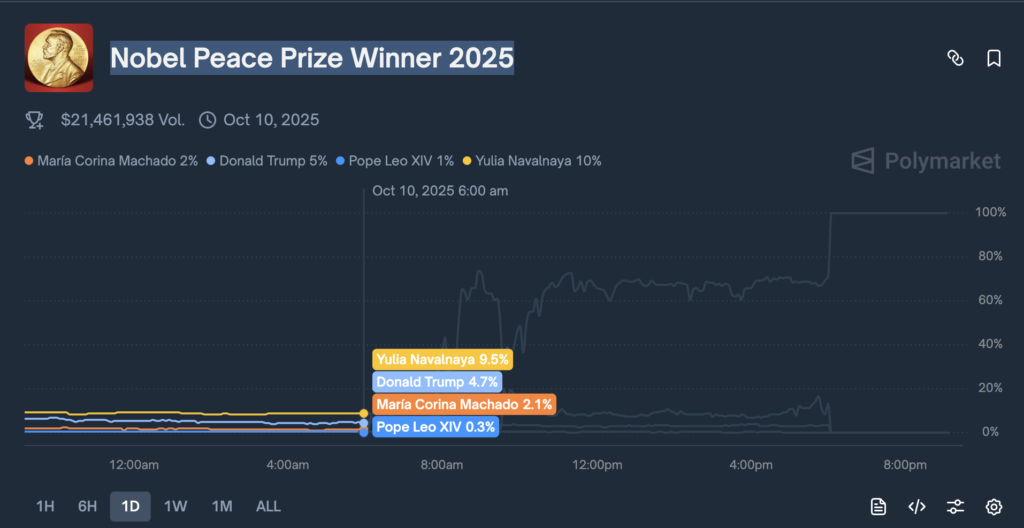
For most of the run-up, Venezuelan opposition leader María Corina Machado traded at only a few percent. Shortly after midnight Norwegian time on the day of the announcement, her price jumped sharply, reaching around 70% hours before the official news on October 10, 2025.
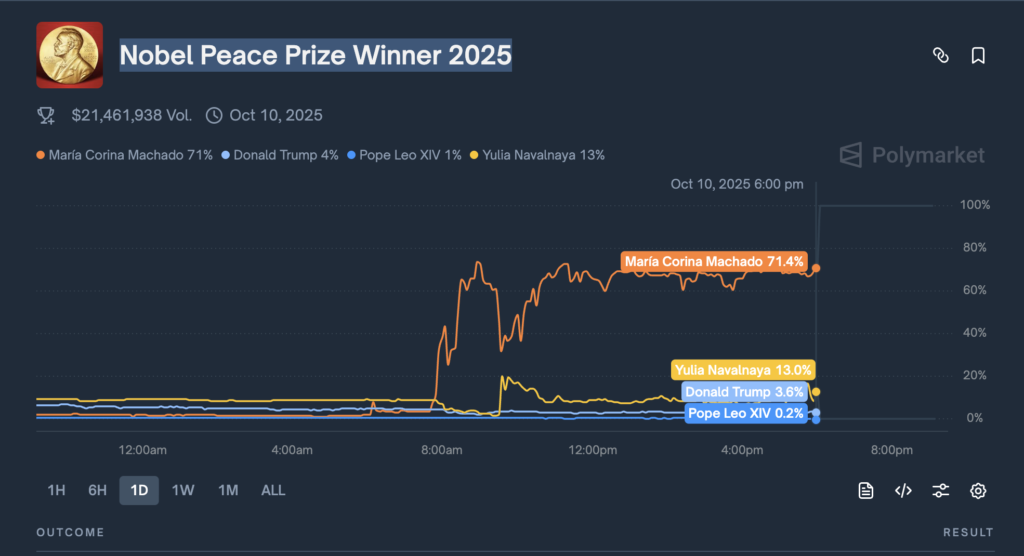
The Norwegian Nobel Institute said it was investigating the surge as a possible leak of confidential information. Reports at the time described large bets from accounts with little or no prior history.
Two lessons follow:
- Prices can move before news. Markets aggregate whatever information traders act on, which is why they are sometimes watched as early signals.
- That information may be improper. A sudden move with no public explanation can reflect leaked or insider information. Ordinary participants on the other side of those trades are at a disadvantage, and trading on misappropriated information can carry legal consequences.
6. Why prediction markets attract attention
Researchers, journalists, and analysts follow prediction markets for several reasons:
- Readable format. A single percentage is easier to interpret than a price chart.
- Cost of being wrong. Participants put money behind their views, which some argue filters out low-effort opinions.
- Real-time updates. Prices adjust continuously as new information arrives.
- Wide topic range. Markets cover politics, economics, technology, culture, and crypto.
These features make prices useful as one input among many. They do not make them reliable forecasts on their own, especially in thin markets where a few large orders can move the price.
7. Key risks
- Total loss of stake. If your outcome is wrong, your shares are worth $0.
- Information asymmetry. Some participants may know more than you, sometimes improperly, as the Nobel case shows.
- Liquidity and spreads. Thin markets can have wide gaps between buy and sell prices and large slippage.
- Resolution risk. Outcomes depend on how a question’s rules are worded and interpreted. Disputes can happen.
- Regulatory risk. Prediction markets are treated differently across countries and may be restricted or illegal where you live.
- Smart contract and platform risk. Funds and settlement rely on code and on-chain infrastructure.
8. Summary
- Prediction market shares settle at $1 or $0, so prices act as implied probabilities.
- A falling price is an unrealized loss and often a sign of new information, not something to dismiss.
- High entry prices pair small gains with large potential losses.
- Early price moves can reflect insider information, which is a risk for ordinary participants.
- Check local regulations before interacting with any prediction market.
How Polymarket Works: FAQ
Is Polymarket easier than trading stocks or crypto? The format is simpler to read, but judging real-world outcomes is not easier, and you can lose your full stake on any market.
If the price drops, am I losing money? Yes, on paper. You only recover if the outcome resolves in your favor, which is uncertain until the end.
Do prediction markets know the news before the media? Sometimes prices move first. That can come from fast analysis, but it can also come from leaked information, which is a known risk.
Is Polymarket legal everywhere? No. Rules vary by country, and some jurisdictions restrict or prohibit access.
References
- Polymarket Docs: Prices & Orderbook
- Bloomberg: Unusual Polymarket Bets on Peace Prize Winner Spur Probe (Oct 10, 2025)
- Blockworks: Polymarket bets trigger Nobel leak probe in Norway
Notice: This research analysis is strictly educational. RedPakPak does not offer investment, trading, gambling, or financial advice, nor does it endorse any platform.