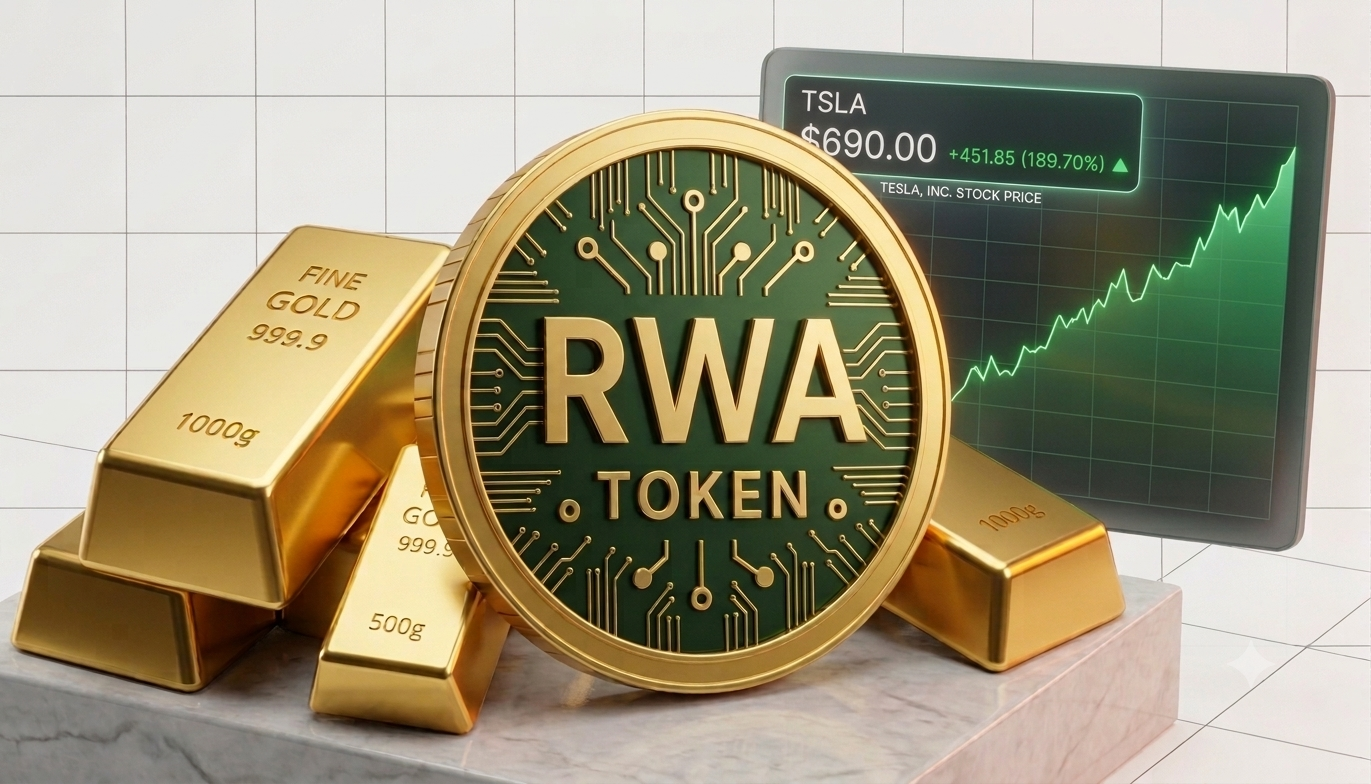
RWA stands for Real-World Assets.
In simple terms, an RWA is a digital token on a blockchain that represents a real physical or financial asset from the off-chain world.
Common Examples of RWAs:
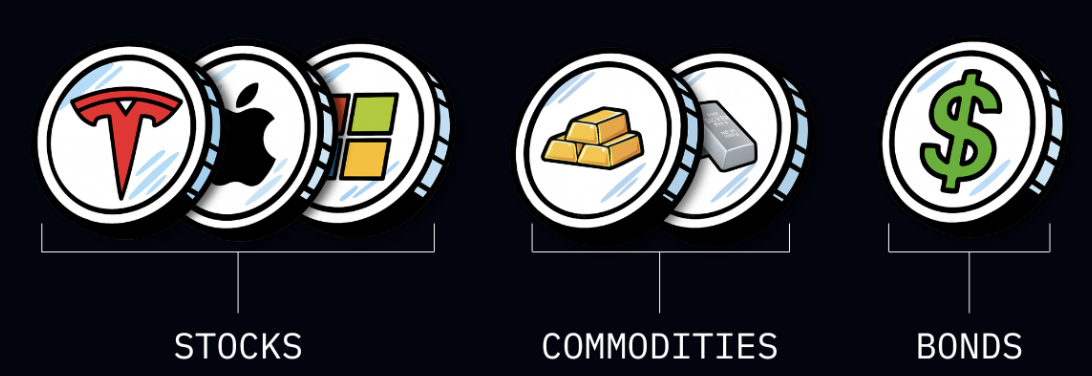
- Financial Assets: U.S. Stocks (e.g., Nvidia, Tesla), Government Bonds (U.S. Treasuries), or Corporate Bonds.
- Physical Assets: Gold, Real Estate, Commodities (Oil, Agriculture), or Fine Art.
While RWA 1.0 focused on illiquid assets like real estate and fine art, RWA 2.0 centers on liquid financial assets like U.S. Treasury bills and equities.
1. The Evolution of RWA (Timeline)
[RWA 1.0: The Past]
- Action: Tokenized high-value illiquid assets (real estate, fine art).
- Process: Issued fractionalized tokens.
- Result: Low liquidity made trading difficult, causing interest to fade due to legal and management friction.

[RWA 2.0: The Present]
- Action: Shifted focus to highly liquid financial instruments (U.S. stocks, T-Bills).
- Process: Brought high-volume, yield-bearing assets on-chain.
- Result: Achieved instant liquidity and 4–5% annual yields directly in Web3 wallets.
2. How Stock Tokens Maintain 1:1 Value (Step-by-Step)
[1. Custody] ──► [2. Oracle Feed] ──►. [3. Arbitrage]
(Buy & Lock Share) (Stream Live Price) (Enforce 1:1 Peg)
Step 1: Real Asset Purchase & Custody (Minting)
- An RWA token issuer (e.g., Ondo Finance) buys 10,000 real shares on the stock exchange.
- The issuer locks these shares in a secure, audited custodian account.
- The issuer mints exactly 10,000 stock tokens on-chain.
Result: Every token is backed 1:1 by a real share in reserve.
Step 2: Oracle Price Feed (The Billboard)
- The real stock price changes on Nasdaq (e.g., Tesla hits $500).
- Blockchains cannot read external data natively, so decentralized oracles (like Chainlink) collect real-time market data.
- The oracle updates the on-chain data feed with the true reference price ($500).
Step 3: Arbitrage & Price Alignment (Market Result)
- If the token price temporarily rises to $520 due to crypto buying pressure…
- Arbitrage bots instantly spot the $20 gap.
- Bots buy the real share at $500 and sell the overvalued token at $520.
Result: Automated trading brings the token price back down to $500 instantly.
3. What Happens During Weekend Trading? (Timeline)
- [Weekend] Traditional stock exchanges close, but stock tokens trade 24/7 on-chain.
- [News Event] Breaking news occurs over the weekend; buyers push the stock token from $500 to $520.
- [Monday Opening] Traditional markets open:
- If news is valid: The real stock gaps up to ~$520 at market open.
- If hype is speculative: Arbitrageurs sell the overpriced tokens at open, pulling the token back to $500.
4. Why RWA? 4 Core Advantages Over Traditional Markets
① 24/7/365 Continuous Trading
Traditional: Market hours are restricted by time zones, weekends, and holidays.
RWA Process: News breaks at midnight → RWA traders buy/sell immediately → Risk managed in real time.
② Global Access & Fractional Ownership
Traditional: Cross-border investing requires international brokerage setups, currency exchange fees, and strict geographical access.
RWA Process: Connect a Web3 wallet → Buy $1 worth of fractional stock → Global access achieved instantly.
③ Instant Settlement (T+0 vs. T+2)
Traditional: Selling a stock takes 2 business days (T+2) to settle funds into usable cash.
RWA Process: Execute a sell transaction → Smart contract executes → Stablecoins hit your wallet in seconds (T+0).
④ DeFi Composability
Traditional: Stocks sit idle in a traditional brokerage account.
RWA Process: Lock stock tokens into DeFi protocols → Use them as collateral to borrow stablecoins → Maximize capital efficiency.
💡 Bottom Line
RWA (Real-World Assets) follows a clear lifecycle:
1) Lock real assets (like stocks or bonds) in custody
2) Stream live prices via Oracles
3) Enforce 1:1 price parity via arbitrage, removing the time, geographical, and settlement limits of legacy finance.